07899 756585
This is Giants Causeway on the North Coast of Northern Ireland, famed around the world for its awe-inspiring hexagonal stone plinths. Incredibly, the stones are built not by a genius mathematician or engineer but by mother nature. In this article I’ll explain how it is that nature can afford us such a beautiful display.
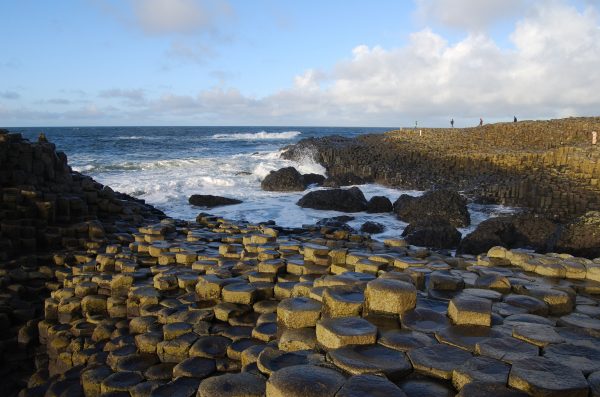
The plinths here are in fact igneous basalt columns, created when molten lava comes up from inside the earth and cools. As the rock cools it contracts, and this changing shape means that as it solidifies the rock must crack to release the pressure (similar to the way that an ice cube warms, contracts and cracks when you put it into your drink).
Read the rest of this page »
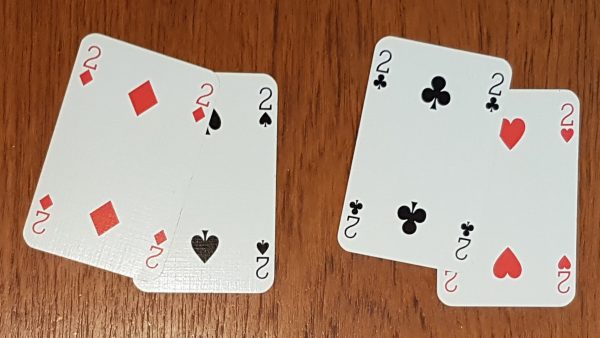
Here are a couple of pairs of deuces:
CONTINUED FRACTIONS: consider this fraction:
Read the rest of this page »

ONE is the only number that’s the same in binary, base 10 and Roman Numerals.
It’s the wheels on a unicycle, the rails on a monorail and the players when you go solo.
One is the first odd number, the first triangular, square, pentagonal and hexagonal number, and the first tetrahedral, cube and Fibonacci number.
Read the rest of this page »
On meeting this adorable litter of ten Dalmation Puppies the other day, I quickly spotted (ahem) the need for Dogarithms – the canine equivalent of logarithms. The conversation with dog breeder Maxine went something like this:
Read the rest of this page »
Jane’s statement seem ridiculous – how can most people be better than average? Using some mathematical trickery, here’s how she could be logically correct.
Read the rest of this page »
Read the rest of this page »
Read the rest of this page »
Read the rest of this page »
Read the rest of this page »
Read the rest of this page »