07899 756585
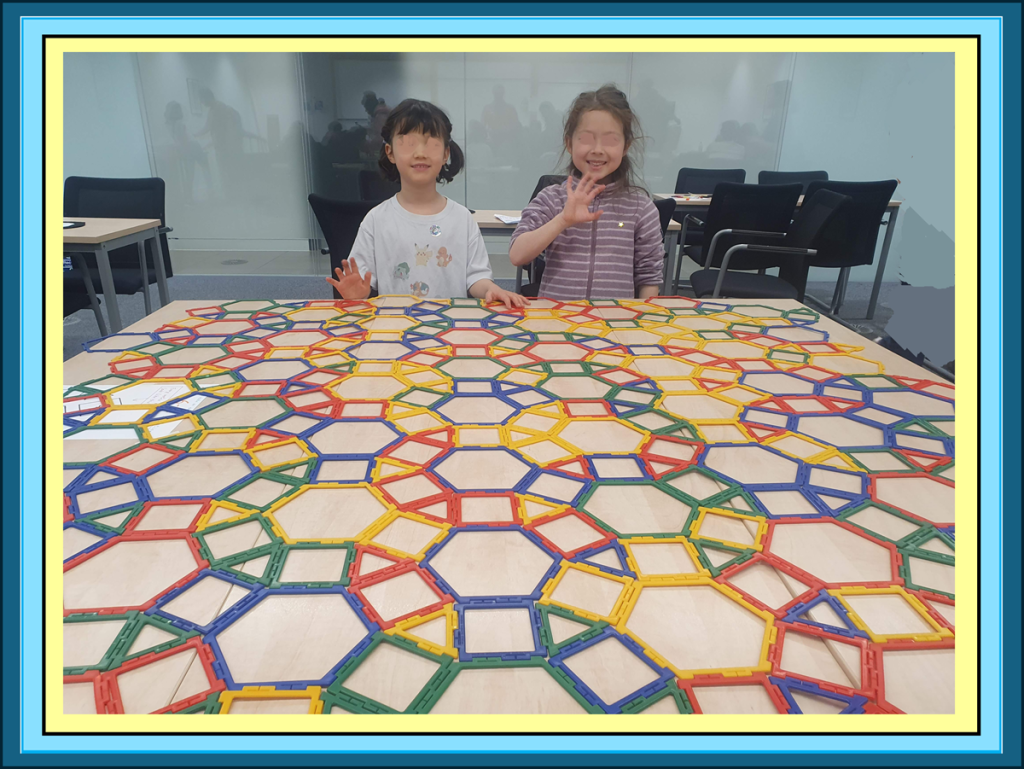
INGREDIENTS: triangles, squares and hexagons. Lots of them! You can use paper, card or any other material, but I like these Frameworks tiles from Polydron.
RECIPE: each vertex of the tesselation is identical! Just arrange a triangle (3), square (4), hexagon (6) then another square (4) around a point, and click them together. Repeat so that every vertex has the same “3-4-6-4” formation, making the tesselation as large as you like. Note that the angles are $30^{\circ}$, $90^{\circ}$, $120^{\circ}$ and $90^{\circ}$, which reassuringly add to the $360^{\circ}$ you need around each point.
CONSTRUCTION TIPS:
1) hexagons only join to squares.
2) triangles only join to squares.
3) never join two copies of the same shape (e.g. don’t join a square to a square).
4) a good start is to grab a hexagon and work around its perimeter joining an alternating sequence of triangles and squares to make a basic “wheel” shape.
TESSELATION: an arrangement of shapes which fit together without leaving any gaps and can tile the entire plane. Think of it as a tiling: tiled floors are usually made up of square or rectangular tiles, but triangles and hexagons also tesselate, as do plenty of other shapes. Regular pentagons do not, because no number of their interior angles $108^{\circ}$ can ever sum to the $360^{\circ}$ you need around a point. Here are some of my other favourite tessellations (from a 2026 tesselation workshop).
At this year’s Oxford Maths Festival (2026), House of Maths was invited to run a tesselation workshop. As an afterthought, as well as the usual triamonds, pentominoes, rhombi and hat tiles, I took along several hundred triangles, squares and hexagons. It took 6 of us around 45 mins to produce the surprise highlight of the workshop: this stunning 3-4-6-4 tesselation. I also presented a brand new 60 minute show “Maths Secrets: How to Look Like a Genius!” with lots of mental maths shortcuts and mind-reading illusions.
RATIO OF TRIANGLES to SQUARES to HEXAGONS:
The ratio in a large tessellation is 2:3:1 (so for every hexagon you will need two triangles and 3 squares to make a huge 3-4-6-4 tesselation). To see why, consider that every vertex is identical: they each feature the following numbers of polygon corners:
TRIANGLES: one corner, so 1/3 of a triangle
SQUARES: two corners, so half a square
HEXAGONS: one corner, so 1/6 of a hexagon.
The ratio of triangles : squares ; hexagons is therefore $\frac{1}{3}: \frac{1}{2}:\frac{1}{6}$ which simplifies to 2:3:1.
Another way to see that the ratio is 2:3:1 is to find a unit consisting of 2 triangles, 3 squares and 1 hexagon that you can repeat to build the entire tessellation. Have a look at the image and see if you can spot such a unit.
I took along 120 triangles, 180 squares and 60 hexagons (count them if you like!), and we pretty much used them all!
EXTENSION: a similar geometrical pattern is 3-4-5-4 but this time instead of a tessellation there is an “angle deficit” (explained below) at each point, so the shape does not lie flat. If you keep going you will gradually build up a 3-dimensional polyhedron (“many faces”) shape called a rhombicosidodecaedron consisting of 12 pentagons (hence “dodeca”), 20 triangles (hence “icosi”) and 30 squares (giving their name to the “rhombi” part of the name).
The angle deficit is because meeting at each vertex of the shape we have a triangle then square then pentagon then square. The interior angles of the four shapes sum to $60+90+108+90 = 348^{\circ} < 360^{\circ}$ required for a tessellation. So there!