WHY DO HEXAGONS OCCUR NATURALLY IN NATURE?
This is Giants Causeway on the North Coast of Northern Ireland, famed around the world for its awe-inspiring hexagonal stone plinths. Incredibly, the stones are built not by a genius mathematician or engineer but by mother nature. In this article I’ll explain how it is that nature can afford us such a beautiful display.
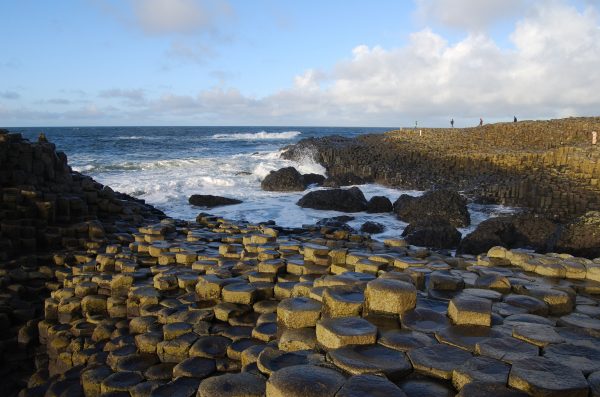
The plinths here are in fact igneous basalt columns, created when molten lava comes up from inside the earth and cools. As the rock cools it contracts, and this changing shape means that as it solidifies the rock must crack to release the pressure (similar to the way that an ice cube warms, contracts and cracks when you put it into your drink).
Read the rest of this page »
WHAT’S INTERESTING ABOUT THE NUMBER $2$?
TWO is the only even prime number, and the number of Ronnies in the famous duo. It’s the sides on a digon (two-sided shape such as the panels of a juggling ball), and it’s what it takes to tango. It’s a dual, a duel, a duo and a twin. Two has two homophones: ‘to’ and another one ‘too’.
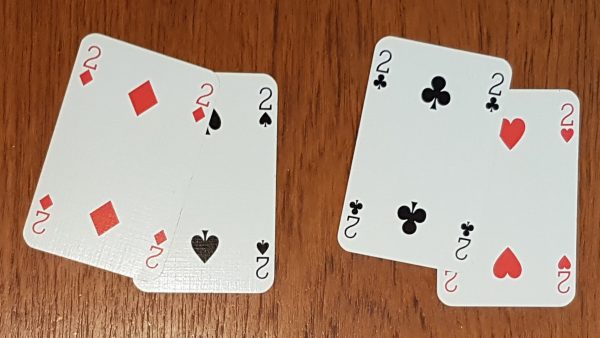
Here are a couple of pairs of deuces:
CONTINUED FRACTIONS: consider this fraction:
Read the rest of this page »

WHAT’S INTERESTING ABOUT THE NUMBER ONE?
ONE is the only number that’s the same in binary, base 10 and Roman Numerals.
It’s the wheels on a unicycle, the rails on a monorail and the players when you go solo.
One is the first odd number, the first triangular, square, pentagonal and hexagonal number, and the first tetrahedral, cube and Fibonacci number.
Read the rest of this page »
WHAT’S THE POINT OF LOGARITHMS?
On meeting this adorable litter of ten Dalmation Puppies the other day, I quickly spotted (ahem) the need for Dogarithms – the canine equivalent of logarithms. The conversation with dog breeder Maxine went something like this:

Read the rest of this page »
FATHER: “How did you do on your maths test?”
JANE: “I did better than average, but then so did most of the class”
Jane’s statement seem ridiculous – how can most people be better than average? Using some mathematical trickery, here’s how she could be logically correct.
Read the rest of this page »
$x$ is the ideal letter to represent the unknown simply because the other letters are so busy doing other things! To demonstrate, here is a small (not exhaustive) collection of mathematical measures, physical quantities and units, using all upper and lowercase letters a to Z (with just two blanks – can you fill them?). Some will be familiar to primary School students; most if not all will be familiar by the end of an A-level mathematics course. Why not see if you can create your own algebra alphabet of mathematical letters first, before reading mine? Good luck!
Read the rest of this page »
Don’t get me wrong: History, Spanish, Music and Drama are all great – even Latin (well, maybe Latin…). All learning is good: studying helps to keep your brain fit in the same way that exercise keeps your body fit, and a good range of both general and specialist knowledge enriches our lives hugely. But trigonometry and quadratic equations transcend Oxbow Lakes, Adverbial Clauses and Post-modernist art because only mathematics has these five extra qualities that make it the indisputable top of the pile!
Read the rest of this page »
This is the story of rotations, reflections, enlargements and translations. It’s about an ingenious shape that lives in millions of households yet that few people have even heard of. And it’s the story of how some simple maths – GCSE transformations and a little geometry – led to a revolution in photography. This is the story of the Roof Pentaprism: a simple yet beautiful solid shape at the heart of every DSLR camera (that’s the posh ones!).
Read the rest of this page »
HOW CAN I MAKE MATHS FUN?
House Of Maths was recently interviewed on the radio about the new GCSE and “real life” maths problems. But while making maths relevant IS important, “keeping it real” doesn’t automatically make maths fun – especially if your teacher is more like Miss Trunchbull than Miss Honey. Instead, here are the six ACTUAL secrets of turning maths from boring to brilliant:
Read the rest of this page »
Isn’t maths great? Everything is either right or wrong, it all makes sense and as long as you follow the rules everything will be ok. Right? Umm… no.
Here are my Ten Commandments of Maths: all were considered to be obviously correct at one time but, as we shall see, rules are made to be broken.
Read the rest of this page »
